



How to Use AI to Design High-Converting Landing Pages for Fishing Charter Bookings
AI is reshaping how fishing charter businesses attract, convert, and retain customers online. From rapid page design to data-driven copywriting and conversion optimization, AI-powered tools allow captains and charter operators to build landing pages that book more trips with less effort. This guide explains, step by step, how to use AI strategically to design landing pages that turn website visitors into paying charter guests.
Table of Contents
- Why AI Matters for Fishing Charter Landing Pages
- Understanding Angler Intent with AI
- Structuring a High-Converting Charter Landing Page
- Using AI for Charter-Specific Copywriting
- AI-Powered Design and Layout Tools
- Personalization and Dynamic Content with AI
- AI for Conversion Rate Optimization
- Building Trust, Compliance, and Credibility
- The Future of AI in Charter Marketing
- Top 5 Frequently Asked Questions
- Final Thoughts
- Resources
Why AI Matters for Fishing Charter Landing Pages
Fishing charter bookings are high-intent, experience-driven purchases. Customers are not just buying a service; they are buying excitement, safety, expertise, and memories. AI helps translate those emotional drivers into landing pages that perform. According to HubSpot research, businesses that use AI-powered marketing tools improve conversion rates by an average of 20 percent. For fishing charters, this means more bookings during peak seasons and better utilization of off-season traffic. AI accelerates page creation, improves messaging accuracy, and continuously optimizes performance based on real user behavior.
Understanding Angler Intent with AI
Before designing anything, AI can help you understand who your customers are and why they are searching. AI-powered analytics platforms analyze search queries, session behavior, and booking patterns to identify intent segments such as first-time anglers, families on vacation, trophy hunters, or corporate groups. Tools like Google Analytics and Hotjar use machine learning to reveal where users hesitate, how far they scroll, and where they abandon a landing page. AI-driven keyword clustering also helps identify intent-based phrases like “deep sea fishing charter near me,” “family-friendly fishing trips,” or “private offshore fishing charter.” These insights directly inform page structure and copy priorities.
Structuring a High-Converting Charter Landing Page
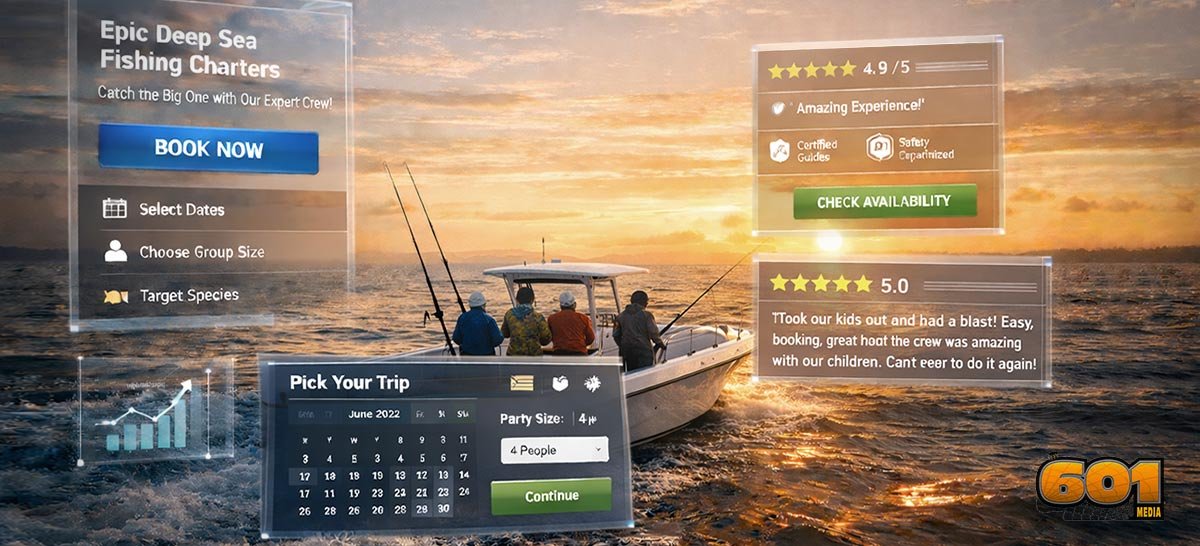
AI excels at identifying proven layout patterns. High-performing fishing charter landing pages consistently follow a structure optimized for trust and urgency. The hero section should immediately communicate location, species, and experience level. AI heatmap analysis shows that users decide whether to stay within the first five seconds. A clear headline, a supporting value statement, and a visible booking call to action are non-negotiable. Mid-page sections should address common objections such as safety, licensing, experience level, and weather conditions. AI tools analyze customer reviews and FAQs to surface the most common concerns automatically. The page should end with social proof and a frictionless booking path. AI booking flow optimization reduces drop-offs by simplifying date selection, group size input, and payment steps.
Using AI for Charter-Specific Copywriting
Generic copy does not sell fishing trips. AI language models trained on travel, tourism, and outdoor recreation data can generate persuasive, charter-specific messaging. Tools like ChatGPT help generate headlines, benefit-focused descriptions, FAQs, and call-to-action variations. The key is prompting AI with real operational details such as boat size, target species, years of experience, and certifications. AI sentiment analysis also refines tone. Family-focused charters benefit from safety-forward language, while sportfishing charters convert better with performance and expertise-driven copy. AI testing frameworks automatically rotate copy variations and identify top performers based on conversion data.
AI-Powered Design and Layout Tools
Design speed is where AI delivers immediate ROI. AI-assisted design platforms generate layouts optimized for readability, mobile responsiveness, and conversion hierarchy. Tools such as Figma with AI plugins and Webflow with AI-assisted components allow non-designers to build professional-grade pages quickly. AI evaluates spacing, color contrast, and visual flow to reduce cognitive load. This is critical for fishing charters, where many users browse on mobile devices while traveling. According to Statista, over 65 percent of travel bookings now originate from mobile devices.
Personalization and Dynamic Content with AI
AI enables real-time personalization based on user location, device, referral source, and behavior. For example, visitors from inland states can see messaging focused on guided experiences and equipment inclusion, while coastal visitors see advanced offshore options. AI-powered personalization engines dynamically adjust headlines, testimonials, and pricing displays. This adaptive approach increases relevance without creating multiple pages. Research from McKinsey shows personalization can increase revenue by up to 15 percent when implemented correctly.
AI for Conversion Rate Optimization
AI removes guesswork from optimization. Machine learning models continuously test button placement, color, wording, and form length. AI-driven A/B testing tools identify statistically significant improvements faster than manual testing. For fishing charters, even a one percent conversion lift can translate into thousands of dollars during peak season. Predictive analytics also forecast booking demand, allowing operators to highlight limited availability or premium time slots dynamically. Scarcity messaging powered by real data significantly improves booking urgency.
Building Trust, Compliance, and Credibility
Trust is a major decision factor in fishing charter bookings. AI helps ensure trust signals are prominent and compliant. AI scans pages for missing credibility elements such as licensing disclosures, safety certifications, insurance mentions, and refund policies. Natural language processing also improves review placement by highlighting the most persuasive testimonials. AI-powered chatbots handle pre-booking questions instantly, reducing uncertainty. When trained on real charter policies, these assistants improve user confidence without replacing human interaction.
The Future of AI in Charter Marketing
AI is moving beyond page creation into predictive experience design. Future landing pages will adapt automatically based on weather forecasts, fish migration data, and local tourism trends. Integration between AI booking systems and marketing platforms will enable fully automated funnels, from ad click to confirmation email. Fishing charters that adopt AI early will gain a measurable competitive advantage in crowded coastal markets.
Top 5 Frequently Asked Questions
Final Thoughts
AI is not just a design shortcut; it is a strategic advantage for fishing charter businesses. When applied thoughtfully, AI improves clarity, trust, personalization, and conversion rates across the entire booking journey. The most successful charter operators will be those who treat AI as a decision-support system rather than a content factory. By aligning AI insights with real-world fishing expertise, landing pages become powerful booking engines instead of static brochures.
Resources
- HubSpot – AI and Marketing Conversion Research
- McKinsey – The Value of Personalization
- Statista – Mobile Travel Booking Statistics
- Google Analytics Documentation